Friday, September 11, 2026


 Book Recommendations

     House of Wind is a haunting story that at times is not easy to read. Wendi’s popular pastor husband Ron is not the same man at home. There, he heaps emotional abuse on Wendi and their children Julia and Chris. Gathering her courage, she takes the kids and heads for a rental home loaned to her by a friend.
     Unbeknown to her, Garret, the renovator, is living there. Garret adds comic relief and sensibility, although Wendi is at first too raw to appreciate him. He’s a bulwark against Ron’s scheming efforts to regain control of them.
     Narcissists aren’t as uncommon as we’d like to think. If you know someone in a similar situation, where the church family and even her personal family turn against her, this is her story.


     In Sanctuary and Sabotage, Trevor goes to Bandry, Texas, to stay with his aunt and uncle after a tragedy on his security detail. He’s stunned to see the pigtailed tomboy grown up to be a gorgeous vet. Strange things are happening at Kinsley’s veterinary farm, but she resists Trevor’s help. She doesn’t tell him her brother Eli, Trevor’s former best friend, is drowning in gambling debt and wants her to sell the ranch. With the covert help of the security firm he works for, he looks for possible enemies and comes up with a few candidates.
     Kinsley has loved Trevor from childhood and the grownup Trevor doesn’t disappoint. He’s wowed by her and dreams of a family of his own. But there’s a problem. She won’t tolerate dishonesty in a man and he hasn’t been forthcoming about his security measures. Will his omissions sabotage their relationship?
      Favorite lines: “I’m okay with knowing God’s already where we’ll someday be.” And “With her looks and yours? Y’all would make some beautiful babies.”

What have you been reading lately?


Wednesday, July 15, 2026

New Covers!

     My first series, Promise For Tomorrow, is now clad in new covers. I asked newsletter readers which they liked best and why. Here are their answers. The reasons why a particular cover was the favorite was so interesting.


    The new No Neutral Ground had the most votes for such reasons as the low-flying plane and the couple clutching each other; the ocean scene; the colors; and the dangers around them and all they could do was watch.

     Soar Like Eagles scored points for the reminder of time spent in the military; it shows what the clubmobile looked like; the characters are smiling with a hint of romance; and the patriotic feel.

     Friends & Enemies’s biggest draw was the children pictured. I decided to create new covers after author Robin Patchen told how her books sold better when children were pictured. Aha! I needed to include baby Paulina.

     Which do you like?


Thursday, April 16, 2026

 Listen For the Chickadees

is out in the world!


She’s loved him forever.
He’s never seen her as more than a memory from home.
Then Pearl Harbor changed everything.

December 7, 1941, shattered the illusion that anyone is safe.

Navy nurse Gloria Bloch wakes to the thunder of enemy planes over Pearl Harbor, certain of only one thing: John Walsh, the boy she has loved since childhood, is far from danger aboard an aircraft carrier. Or so she believes.

When panicked American gunfire brings John down over the harbor, their reunion is brief and breathtaking, forged in chaos neither can escape.

As the Second World War drives the United States into the Pacific conflict, Gloria and John are swept onto separate paths of duty. Gloria serves aboard the hospital ship USS 
Serenity, tending shattered bodies and wounded souls. John flies combat missions as a Navy fighter pilot and combat photographer, risking everything to document a war that refuses to leave him untouched.

Their paths cross again and again in fleeting moments between air raids and surgeries, courage and fear, longing and loss. With every meeting, the feelings they have buried deepen. But war demands more than love. It demands sacrifice, tests faith, and steals time without warning.

When separation stretches into silence, Gloria must face the terrifying possibility that hope itself has become another casualty of war.

As war and distance threaten to pull them apart, only the smallest signs remain: a whistle, a painted bird, and a promise worth holding onto.

Listen for the Chickadees is a Christian World War II historical romance set against the backdrop of Pearl Harbor, the U.S. Navy, and the Pacific War. It is a story of steadfast love, quiet faith, and the courage it takes to trust God when tomorrow is uncertain.

Wednesday, April 8, 2026

 Book Recommendation: Anna of Arimathea

Joseph of Arimathea’s daughter Anna was cruelly wounded by a Roman soldier’s whip, scarring her face and hand, and a horse’s hoof that crushed her hip. Hidden away at their Arimathean estate, she practices the healing arts, isolated and lonely. Then Andrew, a disciple of Jesus, comes with a message for her father. Seriously wounded by bandits, she tends to his injuries and they fall in love. But how can someone crippled like she endure the nomadic life of a follower of Jesus?

Susanne Blumer has written a Biblical novel on the daughter of Joseph of Arimathea. It’s a fascinating look at what might have been. (A sequel, Anna of Bethsaida, is now available.) I asked author Susanne Blumer a few questions.


I love your portrayal of Andrew. How did you decide to pick him to be the main character disciple?
Oh, my sweet Andrew! When I first started working on the book, I knew I needed a disciple. But which one? Peter was already married. John is said to never marry. James is killed in Acts. I ideally wanted one of the inner circle and one that could fall in love with Anna. Andrew made the most sense. He was the first to be called, is involved in many of the important stories, but he also felt like a disciple I could make my own. So Andrew it was, and I'm so happy with my choice. He was perfect for the series!

Have you visited Israel?
No, I have not been, but it is at the top of my bucket list! My husband and I had an amazing trip planned in 2024: Israel, Egypt, Turkey and Greece. We had everything booked and ready to go. Then the war broke out in Israel. We were scheduled to leave a month later. Without knowing what would happen during those weeks, we cancelled the trip. We still hope to do it! The world just needs to calm down a bit first. I cannot wait to go and see all the places I've been writing about!

You own four bookstores in North and South Carolina. How do you decide what books to stock? Do you have a “My Favorites” display?
Each of my bookstores is different. They have different customers who read different things. Of course, we have a lot of books the same between them, but we also have a wide variety that are not. My Beaufort store carries a ton of coastal books, Pat Conroy and authors local to the area. And beach reads. Lots of beach reads!
      My mountain stores each have their own flavor. Even though Black Mountain and Waynesville are just 40 minutes apart, the books we stock vary widely. Our customers simply like different things.
      And yes, we have Staff Picks. It's always fun to see what my staff loves, and our customers like it too!

_______________________________________________________________________________


The Bookworm is an online reader's guide featuring wholesome Christian and Clean books from indie, small press, and traditional publishers. Over 100 books are featured in a variety of genres. Grab your free copy here


Sunday, March 8, 2026

Book Recommendation: ICE

 Book Recommendation

       This book was published in 2002. Yes, twenty-four years ago. I loved it then and I still do. My second-grade teacher introduced me to the solar system, and I was hooked on space. I’ve read scores of astronaut stories and several space novels. Ice is my favorite novel.
       Ice is the story of Apollo 19, which landed at the lunar south pole. (In the real space program, Apollos 18 and 19 were canceled.) When it’s time to leave, Astronauts Gary Lucas and Charlie Shepherd discover their engine won’t ignite, and everyone on Earth thinks they die when their oxygen runs out. Instead, they begin an incredible adventure.
       Is it possible that in prediluvian days, men used their intelligence to travel in space? They lived about sixteen hundred years after creation. They lived for centuries. They were brilliant. Maybe they traveled to other planets and created a base on the moon. All evidence on Earth was wiped out in the flood. Do you think it’s possible?


      The story is sprinkled with famous names from NASA: Jim Irwin, Deke Slayton, Marlyn & Jim Lovell, Susan Borman, Gene Kranz. Their presence adds reality to the novel.
       Preowned copies of Ice can still be found. Sadly, the author, Shane Johnson, died two years ago.

Friday, February 6, 2026

 Book Recommendation: Their Burden to Bear

     Gloria is the star of Listen For the Chickadees, my new book releasing next month. She’s not exactly a new character for me. In the epilogue of my World War One book The Storm Breaks Forth, she’s named as the baby daughter of main characters Peter and Maren Bloch.
     Peter received the Medal of Honor during the fighting in France and joined other Medal of Honor recipients in marching in the procession taking the Unknown Soldier to Arlington. I did a lot of research for that short epilogue. The process of selecting the Unknown is fascinating.
     The U.S. Army Quartermaster Corps teams in France exhumed four bodies from four major American battle cemeteries (Aisne-Marne, Meuse-Argonne, St. Mihiel, Somme). The bodies were placed in identical caskets to ensure anonymity. A decorated WWI veteran, Sergeant Edward F. Younger, walked around the caskets and placed a spray of white roses on one, selecting it as the Unknown Soldier.


     Heather Tabers has written a novel, Their Burden to Bear, about the eight body bearers. Philip is one of them. He’s had a difficult life which haunts him. Since he is single, Elsie is appointed to be his escort during the festivities surrounding the laying to rest of the Unknown. She’s also had trauma in her life. She’s raising her deceased sister’s son with no help from her father.
     Through blackmail, murder, and devious deceit, Philip is Elsie champion and she refuses to let him push her away. A remarkable story.

I asked Heather a few questions:
 

Did you always have an interest in World War I? What is the attraction over WWII?

No, to be honest, I never thought much about WWI at all. I noticed many readers mentioning an oversaturation of books about WWII and I thought, "Why not write a book about WWI?" I love the Roaring 20's and had thought about writing during that time period, but when I began researching WWI, I found so many interesting story ideas.
 

Did you wonder about the Unknown, whether he was an upstanding young father or a scoundrel who joined the army to escape arrest? 

In my heart and mind, the Unknown will always be some woman's little boy, called off to fight in a war. To imagine him as anything else feels unsympathetic to the thousands of women who never got to hug their sons again.
 

Did your husband read your book?

He did! And he loved it. I printed off every chapter the moment I finished it and he read them right away. He was instrumental in helping me get inside Phillip's head.


Monday, January 5, 2026

 Book Recommendation

    I read the Advance Reader Copy of my friend Barb Britton's new release, Across the Lake.
    Inspired by a visit to Galilee, Barb Britton has written six vignettes from passages in the Book of Mark. Many are seen through the eyes of Peter, the fisherman/disciple. My favorite features the disciples being sent out by twos to evangelize. They are animated in a way not gleaned from the Bible. Thomas gestures wildly while relating his experiences. Peter’s muscles ache from rowing in a stormy sea. Judas annoys everyone with his sourpuss attitude.
    Jesus’ only words are those recorded in the Bible. Each story is followed by the author’s reflections and questions for personal study or group discussions. I would have liked more stories!


I asked Barb a few questions:

Why did you use only Jesus’ recorded words?
At the end of the book of Revelation, there is a warning about adding and subtracting from the Bible. I take that very seriously. I wouldn’t want to add words to Jesus’s mouth only to have readers think Jesus said those words. As we know, words have different meanings to different people. I had Jesus say only the red letters. My job was tougher as a writer, but I like the way the book turned out.

Why only Mark’s gospel?
When we were in Israel, our instructor taught from the Book of Mark. I enjoy Mark’s attention to detail and his to-the-point narrative. The four Gospels share some stories, but not others. I focused on healings that took place around the Sea of Galilee.

What’s next?
I’m working on a devotional about Bible heroes who have meltdowns.

Order it hereAcross the Lake releases this Tuesday, January 6.

Monday, November 24, 2025


Black Friday Sale!

Hello Reading Friends,

Are you ready to do some shopping?

My publisher, Scrivenings Press, will have dozens of their ebooks on sale for 99¢

from Wednesday, November 26, through Monday, December 1, including my two latest books.


You can find Seashells in My Pocket at https://www.amazon.com/dp/B0CV4DWFM9 and

No Leaves in Autumn at https://www.amazon.com/dp/B0DXLD4VVC


Other Scrivenings titles can be found here: https://scriveningspress.com/black-friday-2025-sale/


Two more of my books will also be on sale for 99¢ from Wednesday through Wednesday, December 3rd.


You can find Soar Like Eagles at https://www.amazon.com/dp/B07V6R2NWQ and 

Wheresoever They May Be at https://www.amazon.com/dp/B07TDQ9PPB


Stock up now for your winter reading!

Happy Thanksgivings,

Terri


Monday, April 7, 2025


Book Two of Unsung Stories of World War II now available!


No Leaves in Autumn has released. This story is set in Iceland. I’ve never been there, but photos show a beautiful land.

Marie Foubert grew up in an orphanage and struggles with feelings of rejection. As a Red Cross recreation worker, she interacts with the American men based in Iceland during World War II. Her growing attraction to seaplane pilot Stefan Dabrowski excites and concerns her. Won’t he disappear from her life like everyone else?

Stefan hears his commanding officer describe him as exciting as last night’s bathwater. One of his colleagues constantly berates him because of his Polish heritage and his superior flying skill. Despite being the squadron’s most productive pilot, he is threatened with court martial. A showdown approaches to prove who’s the better pilot and the better man.

Marie’s cousin, passing through Iceland, tries to see her after spotting her photo in Life magazine. She declines to meet him, but Stefan encourages her to do so and learn why no one wanted her. She may gain a family after all. 


Tuesday, December 26, 2023

 Cover Reveal!

     Just before Christmas, I received the book cover of my newest book. What do you think?


Here's the blurb:

A US transport pilot and a German-Brazilian woman must outwit

a German saboteur in WWII Brazil.

German-Brazilian Isabel Neumann delights in creating seashell art, but it’s her mathematical ability that lands her a job at the American air base in Natal, northern Brazil during World War II. She doesn’t need a calculator to determine the correct weights and balances for the Air Transport Command’s cargo planes.

Daniel Lambert, an American transport pilot based at Natal, endures the taunts of combat pilots that he is “allergic to combat.” His flying skills win him respect, however, and his friendship with Isabel deepens, even as a new source of trouble looms.

Isabel is caught in the crosshairs of a German saboteur who is obsessed with her. He insists that she belongs with him, and demands that she help him sabotage the Allied base. Her growing relationship with Daniel angers the Nazi, who will do anything to get rid him. What will happen to Isabel if the madman captures her? 


Watch for Seashells in My Pocket, releasing March 12.

Monday, June 12, 2023

The Second Pearl Harbor Attack

           While searching for a bit of information on Pearl Harbor, I learned of Japanese actions in Hawaii in the weeks after their infamous raid on Pearl Harbor on Dec. 7, 1941. Actions I had never heard about.

The Japanese failed in their most critical objective: the destruction of the American aircraft carriers. Worse, they failed to destroy the oil reserves at Oahu, and the damage to docks and yards was slight.

In the weeks after December 7, Japanese submarines continued to patrol off Hawaiian beaches. At sunset on December 15, shells were fired into the port facilities at Kahului on Maui. Three projectiles caused $700 damage at a pineapple cannery. On the night of December 30, subs returned to Kahilui and also hit Nawiliwili on Kauai and Hilo on the Big Island.

On the night of January 28, 1942, a US Army transport carrying soldiers between islands crossed the path of a Japanese submarine. The sub attacked, killing twenty-four of the sixty men on board.

Needing information on the U.S. fleet’s ability, the Japanese Navy considered a second attack necessary. This attack would be carried out with long-range flying boats refueled by submarines.

Three objectives included assessing the damage of the original attack to the infrastructure at Oahu, disrupting salvage efforts, and terrorizing the population. If successful, the Japanese would carry out additional raids.

They planned a nighttime raid, launching flying boats from the Wotje Atoll in the Marshall Islands. Their Kawanishi H8k had an extreme range that allowed them to fly the 1,900 miles to French Frigate Shoals in the northwestern Hawaiian Islands. There they would rendezvous with submarines for refueling. The planes would then fly to Oahu to carry out the attack.

Their primary target was the Pearl Harbor naval base docks to disrupt salvage and repair efforts. Additionally, they were to make careful observations to determine American capabilities. The date of this attack was March 4, 1942, when a full moon offered maximum visibility.

The attack was doomed from the start. Only two aircraft were sent. A submarine to be positioned south of French Frigate Shoals to give a weather report disappeared in mid-February. The moonlight proved to be inadequate.

Unable to see Oahu due to a wartime blackout, one pilot presumably dropped his bombs into the ocean. The other bombed the slopes of Tantalus Peak, an extinct volcano cinder cone north of Honolulu, where it narrowly missed Roosevelt High School. The detonations 900 feet away shattered the school’s windows.

Honolulu’s President Theodore Roosevelt High School has the distinction of surviving an enemy bombing attack. The National WWII Museum


In the days before the attack, American codebreakers warned that the Japanese were preparing raids and would refuel at French Frigate Shoals. American ships patrolled the French Frigate Shoals for the remainder of the war, denying the Japanese further use of the base to carry out reconnaissance missions. This left them unable to continue observing U.S. Navy activity or to keep track of the American carriers. These changes would prove pivotal when, three months later, the two nations’ fleets converged at Midway.

Tuesday, June 21, 2022

The Unlikely Namesake

Genealogy is a hobby for me. While searching old newspapers for any reports on Wangard, I discovered not a relative, but a steamship with my surname. The S.S. Wangard was a German cargo ship built in 1906.

The first mention I found stated that, in February, 1908, overcome by work and worry brought on by damaging seas in far northern latitudes, the 64-year-old Chief Office died of heart disease. The ship was en route from Seattle to Japan, and the officer was buried at sea. Sounds like the Wangard was a stressful place to work.

The ship sustained $8,000 in damage from the heavy waves, and was dry docked in Japan for repairs. After a month-long voyage, it arrived in Tacoma with six thousand tons of coal.


            In September of that year, the Wangard was in Australian waters when a 15-year-old German boy adrift in a boat near Melbourne. He claimed he had been shipwrecked on the Wangard sixteen days previously. The crew of twenty-one left the ship in four boats, and it foundered half an hour later. The boy lost his three companions one by one before his boat beached at Mornington.

It seems the boy had been put aboard the Wangard by the German Consul to be taken to Newcastle in New South Wales, a distance of about 700 nautical miles (or 800 miles). Not wanting to go there, he slipped over the stern while anchored in the bay and helped himself to one of the boats. What repercussions he may have faced is unknown.

The last mention I found came under the headline, Steamer and Cargo Will Have to Be Abandoned—Was En Route From Tacoma to Europe.

The Wangard went ashore on Punta Mogotes off the Argentine coast on January 11, 1909. For a big freighter of 2,736 tons, with a heavy cargo of 210,709 bushels of grain, there was little chance of escaping the rocky coast. The cause for going aground was not stated.

The question I am left with is, how did the ship come to be named Wangard?

Wednesday, February 2, 2022

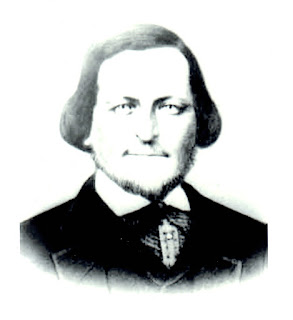
Gerardus Vogelzang, My 2nd Great-Grandfather


Topics we study in history books affected our ancestors in ways we may never realize. For most of my ancestors, I know little about them, but they are my history.


Gerardus Vogelzang, My 2nd Great-Grandfather

2 June 1823    Sambeek, Boxmeer, Noord-Brabant, Netherlands

5 Sept 1876    Green Bay, Wisconsin, USA


When I first began studying my family’s genealogy, I thought I had 3/4 German ancestry, 1/8 Belgian, and 1/8 French. Years later, I learned the Belgian and French Canadian were both 1/16, and I have 1/8 Dutch ancestry.

My great-great-grandfather Gerardus Vogelzang (bird song) had Americanized his name to George Vogels, making his history hard to trace. Once I knew he was Dutch, I found him on the CD, “Immigration Records, Dutch in America 1800s.”

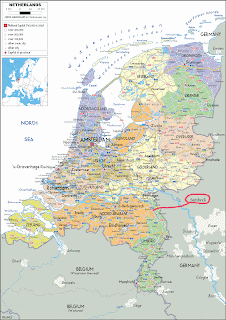
He was born in Sambeek in southern Netherlands, close to the German border. In 1850, Sambeek had a population of about 1,300. At age 33 in 1857, George emigrated to America, hoping for economic improvement. He was a farmer, in the “less well to do” social class.

Some time in the next eight years, he married Theodora Maria Van der Heiden, now known as Mary Vogels. They had six children, the youngest being my great-grandmother Kate, born in 1875. According to the 1870 census, George’s three teenage nephews had come from the Netherlands and were living with the family. His brother and sister-in-law had died in 1867 and 1861. George too died in 1876, nineteen months after Kate was born.

Typical for widows with young children and a farm, Mary remarried a year later and had three more children.

One of my favorite genealogical websites for Dutch ancestry is https://www.wiewaswie.nl/en


Wednesday, January 26, 2022

Josephine Denis


Topics we study in history books affected our ancestors in ways we may never realize. For most of my ancestors, I know little about them, but they are my history.


Josephine Denis, My 2nd Great-Grandmother

21 Jan 1849   Grez-Doiceau, Belgium

21 April 1924    Green Bay, Wisconsin


For the longest time, Josephine was a mystery. From her marriage certificate, I learned her parents were Frank and Florence. From the 1860 census, I learned that as a 12-year-old, she lived with two men: a 40-year-old from Belgium and a 17-year-old from Holland. The men were laborers. She was a domestic. From that I surmised her family was poor and she had to work as a maid.

Then, a stroke of luck! Through a contact in Belgian research in 2018, this family line broke wide open. “Frank” and “Florence” were actually Jean Francois Denis and Marie Florence Vanschoelandt. (In France, Germany, and other Catholic countries, boys were given the first name Jean or Johan, and girls were named Marie or another saint’s name in the belief the saint would be a heavenly intercessor for them.)

The Denis family lived in Grez-Doiceau, Belgium, until Florence died in 1856. Frank and the children immigrated to Wisconsin and its thriving Belgian community, but then Frank sent his children away. Dispersing the children wasn’t uncommon when a parent died, but then why didn’t Frank stay in Belgium where he had family who may have helped?

I’ve learned what happened to Josephine’s two brothers. The 14-year-old served as a laborer with a young Canadian family in Fort Howard, near Green Bay. The younger brother lived with a Wisconsin woman and her two grown daughters who worked as seamstresses. It seems to me that Josephine would have had a better life living with the women for whom she could have learned a trade.

At the age of nineteen, she married Moses Martell. They had six children, at least four of whom grew to adulthood. One of them, Moses Jr., was my great-grandfather. I remember he always had pink and white mints for my sister and me.

Wednesday, January 19, 2022

Marguerite Lamirault


Borrowing an idea from a friend, I am writing vignettes of some of my ancestors. Topics we study in history books affected our ancestors in ways we may never realize. For most of my ancestors, I know little about them, but they are my history.

Marguerite Lamirault, My 8th Great-Grandmother

c 1645  •  Saint-Germain L'Auxerrois, Paris, ÃŽle-de-France, France

17 Oct 1706  •  Quebec City, Quebec, Canada

            King Louis XIV of France desired that his land in the new world, called New France, be populated. Soldiers who stayed behind after fighting the Indians that threatened the settlements needed wives, or they would return to France. The king offered a dowry of fifty pounds if a woman married a solider or common settler, and 100 pounds if she married an officer. In addition, she was given a small hope chest which contained the following:


One head dress                                     One taffeta handkerchief

One pair of shoe ribbons                     100 sewing needles

One comb                                               One spool of white thread

One pair of stockings                           One pair of gloves

One pair of scissors                               Two knives

1,000 pins                                                One bonnet

Four lace braids                                    Ten pounds in silver money


 These marriageable young women were called Filles du Roi, daughters of the king. They are considered the mothers of Canada. At least eight of my ancestors are numbered among them.

One of the women who traveled to New France at the king’s expense was Marguerite Lamirault. Since she had a dowry of 300 pounds at the marriage and since her parents were still living, poverty did not prompt her to undertake the journey to a strange, dangerous land.

More likely, she already knew one of the soldiers. The Lamiraults lived withing five blocks of Honoré Martel in Paris. His father and Marguerite’s father were undoubtedly in contact. Honoré’s father was a horse merchant and Marguerite’s father was a coachman for the queen. Despite a 13-year age difference, Marguerite and Honoré may have been sweethearts, or their fathers arranged their marriage. Taking the king’s offer was an opportunity to increase her dowry and receive free passage to Canada.

The Lamiraults lived on rue des Poulies, the street that runs between Le Louvre, where the royal family lived, and the Saint-Germain l’Auxerrois church where Marguerite was baptized. Moving from Paris to the wilderness of Quebec must have been quite a shock for her.

She and Honoré were married on the morning of 17 November 1668 in Quebec. Marguerite was declared not able to sign the marriage contract, but Honoré could. They settled into a country life, beginning in the town of Sillery. Being from a city family, however, Honoré was not suited to the life of a farmer. After farming for twenty years without much success, he went into the lumber trade. He leased a house in the Upper-Town of Quebec that contained a cellar, two rooms on one floor, one of which was furnished as a foyer, and an attic.

Marguerite gave birth to fourteen children between 1669 and 1691. Four died in infancy. Her sixth child, Paul, was my seventh great-grandfather. She died on 17 Oct 1706.


Wednesday, January 12, 2022

Honoré Martell

 Borrowing an idea from a friend, I am writing vignettes of some of my ancestors. Topics we study in history books affected our ancestors in ways we may never realize. For most of my ancestors, I know little about them, but they are my history.


Honoré Martell, My 8th Great-Grandfather

 c 1632   Saint-Eustache, Paris, France

 1712-1714    Quebec City, Quebec, Canada


In 1663, New France, the present Quebec, was home to 2,500 French people. They were under threat from the Iroquois and the English colonies further south on the Atlantic coast. On 30 June 1665, the Carignan Regiment arrived. One of four companies was quartered at Quebec. One of the soldiers was Honoré Martell.

When the company returned to France in October of 1667, Honoré elected to remain. The following year, he signed a commitment to work for a resident of Gaudarville, seeding an arpent of land and clearing felled trees from two other arpents. (Arpents were long narrow parcels of land of about .845 acres, usually along navigable streams.)

On 26 Nov 1668, he married Marguerite Lamirault in the Church of Notre Dame in Quebec. Marguerite was from Saint-Germain-l’Auxerrois, a parish very near Saint-Eustache.  If they hadn’t known each other in Paris, and she was thirteen years younger, they were familiar with the same neighborhoods.

She had arrived in Quebec that year as a Fille du Roi, daughter of the king. Louis XIV, the Sun King, sponsored the emigration of marriageable girls to Quebec to keep young men from leaving.

Honoré did not make a good farmer. He had to appear before the provost numerous times. Problems included the death of a rented ox, boundary lines, quarrels with neighbors, neglecting to pay debts.

After twenty years, he finally began a new career as a longsawyer in 1688, providing planking and satisfactorily fulfilling contracts.

Marguerite died on 17 Oct 1706 at the age of 62. She’d borne fourteen children, nine of them still living and five not yet married. A year later, Honoré married Marie Marchand, but he had health problems. Four times he was hospitalized. He died between June 1712, when he attended his son Jean’s marriage, and September 1714, when his youngest, Marie-Thérèse married with both parents deceased.

Wednesday, January 5, 2022

Joseph Wangard

     Borrowing an idea from a friend, I am writing vignettes of some of my ancestors. Topics we study in history books affected our ancestors in ways we may never realize. For most of my ancestors, I know little about them, but they are my history.

 Joseph Wangard, My Great-Great-Grandfather 
 7 May 1846 • Bickenbach, Sankt Goar, Rheinland, Germany 
 25 Aug 1925 • Milwaukee, Wisconsin 

Joseph & Barbara sit in the front. Their son John is behind Joseph.


        The second of seven children, Joseph married his wife, Barbara Liesenfeld, on 16 Feb 1874. Seven months later, he departed from Hamburg on 30 Sep 1874 aboard the Cimbria. He was listed as a shoemaker.
       He and Barbara first settled in Cedar Creek, Washington County, Wisconsin. From the birthplaces of their eight children, they moved around Washington County frequently until finally staying in Milwaukee. Their eldest, John, was my great-grandfather. 
        Three of Joseph’s brothers also emigrated to the U.S. Another brother stayed in Germany. His children, Hans, Josefine, and Benno, inspired my debut novel, Friends & Enemies.  
        According to family lore, Joseph wore a full beard to hide a saber scar he received while fighting in the Franco-Prussian War of 1870-1871. 
       At the age of 82, he was struck and killed by an automobile while walking to a neighborhood drug store for ice cream. He had waited for an eastbound vehicle to pass, then walked directly into the path of a westbound car. 


        In an interesting aside, the Cimbria sank in 1883, the biggest civilian maritime tragedy in German waters. The 16-year-old steamship operated by the Hamburg-Amerika Line sailed from Hamburg on 18 Jan 1883 with 302 passengers and 102 crewmembers. In a heavy fog that morning off the North Sea island of Borkum, a smaller steamer crashed into Cimbria’s portside. Seven lifeboats were inflated, but they weren’t filled to capacity. Three disappeared in the fog. Hypothermia and drowning claimed 357 lives. The disaster made headlines around the world. I wonder if Joseph, busy raising a young family, heard the news.


Heidi became a widow when her husband’s U-boat sank in the Atlantic. She wonders how her American school chum Rachel is faring. Her husband Paul must be at war too. One day a strange man approaches her. But no, he’s not a stranger. Paul, now a widower, has been shot down over Germany. With German ancestry, he’s fluent in their language. She takes him home to pose as a German soldier. They’re betrayed and the Gestapo comes calling. They flee across Germany in a desperate journey for Allied lines. 
https://www.amazon.com/dp/B07SYML26R